
More and more of your customers aren’t typing short keywords into Google anymore. They ask ChatGPT, Gemini or Perplexity full questions like “Which digital marketing agency in Athens is best for a small e-shop?”, and they trust the answer. If your business isn’t part of that answer, you’re invisible to a fast-growing share of buyers.
This guide explains how AI assistants decide which businesses to mention, and the practical steps you can take to get recommended by ChatGPT, Google AI Overviews and other AI search tools. This is what we call GEO (Generative Engine Optimization).
Why AI Search Matters for Your Business
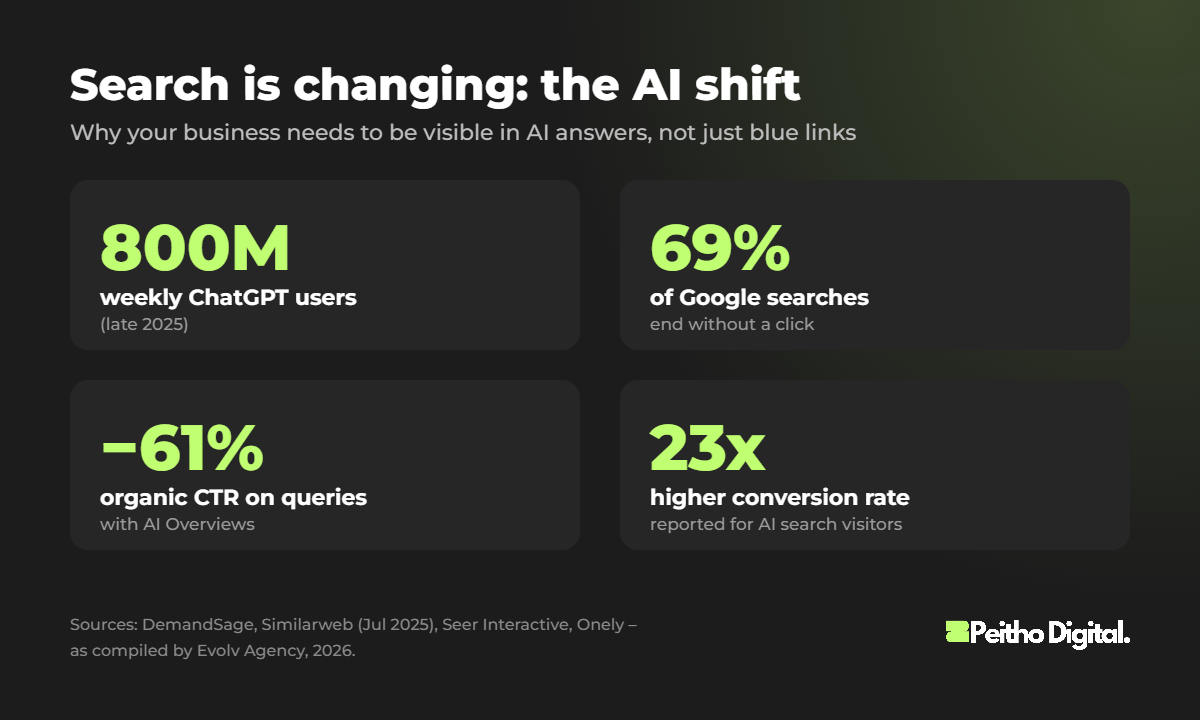
The shift is happening fast. According to figures compiled by Evolv Agency:
- ChatGPT reached around 800 million weekly users by late 2025 (DemandSage).
- 69% of Google searches now end without a click (Similarweb, July 2025), often because the answer is shown directly on the results page.
- On queries with AI Overviews, organic click-through rates dropped by around 61% (Seer Interactive).
- Visitors who do come from AI search are reported to convert far better than average organic visitors, because they arrive already convinced.
In short: fewer clicks, but much more valuable ones. The businesses that AI tools mention will win those customers.
SEO vs GEO: What’s the Difference?
| Traditional SEO | GEO (AI search) | |
|---|---|---|
| Goal | Rank in the top 10 blue links | Be mentioned or cited in the AI answer |
| User behaviour | Short keywords, clicks to compare | Full questions, trusts one summary |
| What matters most | Keywords, links, technical health | Clear facts, authority, consistent mentions across the web |
| Success metric | Rankings & organic traffic | Mentions, citations & AI referral traffic |
The good news: GEO is built on top of good SEO. AI tools still rely on search indexes (Google’s, Bing’s and their own) to find information, so a technically healthy, well-ranked website is your foundation.
How AI Assistants Decide Who to Recommend
When someone asks a question, AI search tools look up relevant pages, then summarise what they find. They tend to favour sources that are:
- Easy to access and understand: crawlable pages with clear structure and direct answers.
- Consistent: the same facts about your business (name, services, location) appear across many sites.
- Trusted: mentioned by other reputable websites, directories, reviews and media.
- Specific: pages with concrete details, numbers and examples are easier to quote than vague marketing copy.
10 Steps to Get Recommended by ChatGPT & Google AI
1. Let AI crawlers access your website
Check your robots.txt file. Make sure you’re not blocking Googlebot, Bingbot or search crawlers like OAI-SearchBot (used by ChatGPT search) and PerplexityBot. Some security plugins and CDNs block them by default.
2. Get indexed in Bing, not just Google
Many businesses only think about Google, but several AI tools also rely on Bing’s index. Set up Bing Webmaster Tools (you can import your Google Search Console data in a few clicks) and submit your sitemap.
3. Be crystal clear about who you are
AI tools need to understand your business as an entity. Your homepage and About page should state plainly what you do, who you help, where you’re based and what makes you different. Avoid vague slogans that could describe any company.
4. Add structured data (schema)
Use Organization or LocalBusiness schema, Service schema on service pages and FAQ schema where relevant. Structured data turns your key facts into a format machines can read without guessing.
5. Write answer-first content
Use real customer questions as headings and answer them in the first 1–2 sentences, then add detail. A clear 40–60 word answer is exactly the kind of text AI tools like to quote. Our SEO pricing guide is a good example of this format.
6. Publish original data and real examples
Statistics, prices, timelines, case studies and before/after results make your content worth citing. Generic advice is everywhere; your own numbers and experience are not. See how we present results in our case studies.
The Peithō Way: For every article we publish, we ask one question: “What can we say here that nobody else can?” Usually the answer is a real number, a real client result or a strong opinion based on experience.
7. Get mentioned on other websites
AI tools build their picture of your business from the whole web, not just your website. Aim for mentions in industry directories, local business listings, partner websites, interviews, podcasts and “best of” lists. Consistent, positive mentions are one of the strongest GEO signals.
8. Strengthen your Google Business Profile and reviews
For local questions (“best accountant in Marousi”), AI answers lean heavily on Google Business Profile data and reviews. Follow our 12-step Google Business Profile optimization guide to get this right.
9. Keep your content fresh
AI tools prefer up-to-date information, especially for prices, statistics and anything with a year in the question. Review your key pages regularly, update numbers and show the last-updated date.
10. Consider adding an llms.txt file
llms.txt is an emerging proposal for a simple text file that summarises your website for AI tools. Major AI platforms haven’t confirmed they use it yet, so think of it as a low-effort extra, not a magic switch. On WordPress, SEO plugins like Rank Math can generate it for you.
How to Measure Your AI Visibility
- Google Analytics 4: check referral traffic from chatgpt.com, perplexity.ai, gemini.google.com and copilot.microsoft.com.
- Manual prompt tests: once a month, ask ChatGPT, Gemini and Perplexity the questions your customers ask, and note whether you’re mentioned.
- Google Search Console: watch impressions for question-style queries; rising impressions with fewer clicks often means you’re appearing in AI Overviews.
- Ask new leads: add “ChatGPT / AI assistant” as an option in “How did you hear about us?”.
Common GEO Mistakes to Avoid
- Blocking AI crawlers by accident with security settings.
- Writing long, vague introductions before getting to the answer.
- Inconsistent business details across directories and social media.
- Chasing “AI tricks” instead of building real authority and helpful content.
- Ignoring Bing completely.
Frequently Asked Questions
What is GEO (Generative Engine Optimization)?
GEO is the practice of optimising your website and online presence so that AI assistants like ChatGPT, Google AI Overviews, Gemini and Perplexity understand your business and mention or cite it in their answers.
Can I pay to appear in ChatGPT answers?
You can’t pay to be included in ChatGPT’s organic answers. Visibility comes from being easy to find, clearly described and well-referenced across the web.
Is SEO dead because of AI search?
No. AI search tools still rely on search indexes to find information, so strong SEO is the foundation of GEO. What changes is how you structure content and build authority.
How long does it take to appear in AI answers?
It varies. Technical fixes like unblocking crawlers can help quickly, while building authority and third-party mentions is a longer process that usually takes months.
How do I know if ChatGPT recommends my business?
Ask it the questions your customers would ask, track referral traffic from AI tools in Google Analytics 4, and ask new leads how they found you.
Want Your Business to Show Up in AI Answers?
We help businesses in Greece and across Europe get found on Google and in AI search. Book a free strategy session and we’ll check how visible your brand is today in ChatGPT, Gemini and Google AI Overviews, then show you what to fix first. Learn more about our SEO, GEO & AI search services.