
“How much does SEO cost?” is one of the first questions every business owner asks us, and the honest answer is: it depends on what you need and how competitive your market is. But “it depends” isn’t very helpful, so in this guide we break down real 2026 prices, what you actually get for your money, and how to tell good SEO from expensive guesswork.
Short answer: most small and medium-sized businesses invest between $1,000 and $2,500 per month for professional SEO. Highly competitive industries or large websites often spend $5,000–$15,000+ per month. One-off SEO projects usually start around $1,500.
1. SEO Pricing in 2026 at a Glance
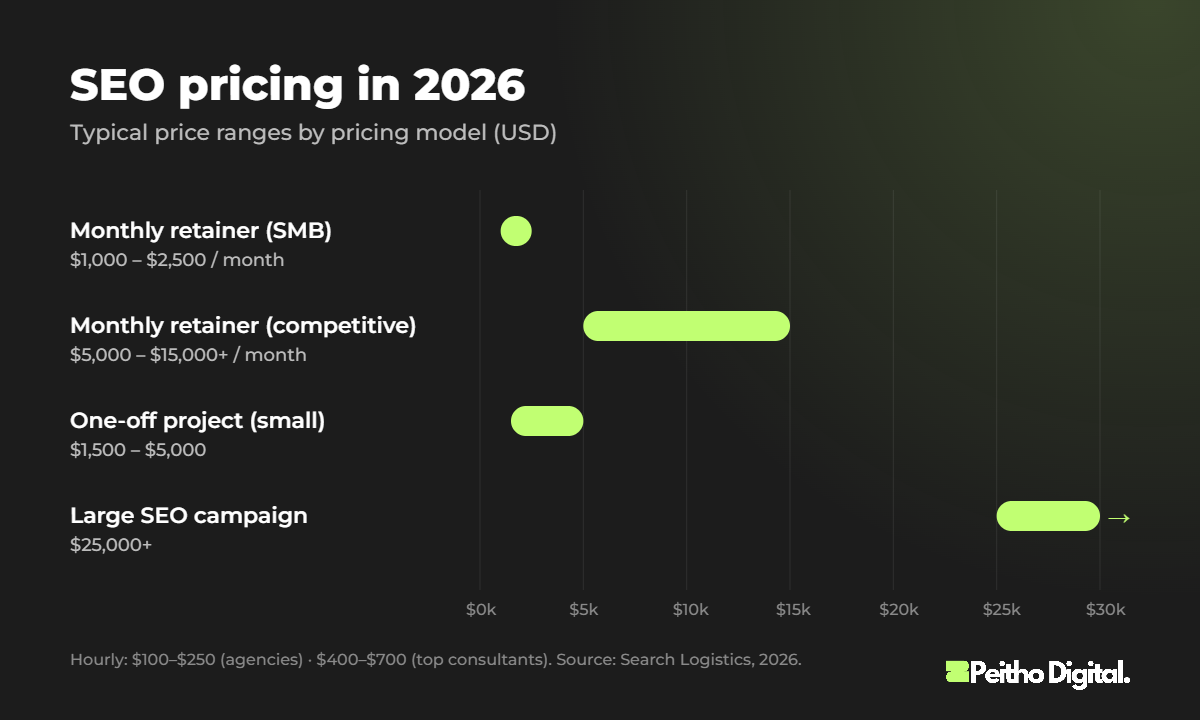
According to Search Logistics’ 2026 SEO pricing research, these are the typical price ranges you’ll see on the market:
| Pricing model | Typical price (2026) | Best for |
|---|---|---|
| Monthly retainer | $1,000 – $2,500 / month | Small & medium businesses that want steady growth |
| Monthly retainer (competitive markets) | $5,000 – $15,000+ / month | E-commerce, legal, finance, large websites |
| Hourly consulting | $100 – $250 / hour (agencies) $400 – $700 / hour (top consultants) | Audits, training, specific questions |
| One-off project | $1,500 – $5,000 | Technical audit, site migration, launch SEO |
| Large SEO campaign | $25,000+ | Big sites, multiple markets or languages |
The same research found that around 70% of agencies raised their prices in 2025, mainly because of inflation and the extra work that AI search (Google AI Overviews, ChatGPT, Perplexity) now requires. In Greece and much of Europe, local agency prices often start lower than US rates, but the rule is the same everywhere: the cheapest offer is rarely the best value.
2. What You’re Actually Paying For
Good SEO is not one task, it’s a combination of work that builds on itself every month. A proper SEO budget usually covers:
- Technical SEO: site speed, crawl errors, indexing, mobile experience, structured data (schema).
- Keyword research & strategy: finding the searches your customers actually make, and the ones you can realistically win.
- On-page optimisation: titles, meta descriptions, headings, internal links and content structure.
- Content: service pages, blog articles and FAQs that answer real customer questions.
- Link building & digital PR: earning mentions and links from relevant, trustworthy websites.
- Local SEO: Google Business Profile, reviews and local citations, essential if you serve a specific city or region.
- AI search optimisation (GEO): making your brand easy for AI assistants to understand, quote and recommend.
- Reporting: clear monthly results focused on traffic, leads and sales, not vanity metrics.
The Peithō Way: We start every SEO project with a technical audit. There’s no point creating new content if Google can’t properly crawl and understand the website you already have.
3. The 4 Most Common SEO Pricing Models
Monthly retainer
The most common model. You pay a fixed monthly fee and the agency works continuously on your SEO. Because SEO compounds over time, this is usually the most cost-effective option for long-term growth.
Project-based pricing
A fixed price for a defined piece of work: an SEO audit, a website migration, or optimising a new website before launch. Great when you have a clear, one-off need.
Hourly consulting
Useful if you have an in-house team and need expert guidance, training or a second opinion. Less useful if you need someone to actually do the work every month.
Performance-based SEO
You pay only when you hit specific rankings or results. It sounds attractive, but be careful: it can push agencies towards easy, low-value keywords or risky tactics that win short-term rankings and lose them later.
4. What Makes SEO Cost More (or Less)?
- Competition: ranking for “lawyer Athens” is much harder than ranking for a niche B2B product.
- Website size: a 10-page service website needs far less work than an e-shop with 2,000 products.
- Starting point: a slow website with technical issues needs fixing before growth can start.
- Local vs national vs international: targeting one city costs less than targeting several countries.
- Languages: Greek and English versions mean double the keyword research and content.
- Content needs: if you need many new pages or articles, the budget grows accordingly.
5. Cheap SEO: 5 Red Flags to Watch For
If an offer looks too good to be true, it usually is. Watch out for:
- “Guaranteed #1 on Google.” Nobody can guarantee rankings; Google itself warns about this.
- Very low monthly prices with no clear list of what work is being done.
- Bulk link packages (“500 backlinks for €99”). These can get your site penalised.
- No access to your data: you should always own your Google Search Console, Analytics and website.
- No reporting or reports full of numbers that never mention leads or sales.
The Peithō Way: You always keep full ownership of your website, your accounts and your data. If we ever stop working together, everything stays with you.
6. How Long Before You See Results?
SEO is a long-term channel. Technical fixes can show results within weeks, but stronger rankings and steady organic traffic typically build over several months, depending on your competition and your starting point. That’s why many businesses combine SEO with paid advertising: ads bring leads from day one while SEO grows in the background. We explain the difference in detail in Paid Search Ads vs SEO.
7. Is SEO Worth the Investment?
Unlike ads, SEO doesn’t stop working when you stop paying. A page that ranks well can bring in customers every day for years. That’s why SEO usually delivers one of the best long-term returns in digital marketing: Search Logistics reports an average ROI of around 748% for high-quality SEO.
A real example: we helped an aluminium panel manufacturer reach #1 on Google in Greece for its most important product keyword, ahead of international brands. You can read the full SEO case study here.
8. How to Set Your SEO Budget
- Start with your goals: how many new leads or sales do you need per month?
- Know your customer value: if one new client is worth €2,000, even a few extra leads a month can pay for SEO many times over.
- Check your competition: search your main keywords and look at who ranks. Strong competitors mean a bigger budget or a longer timeline.
- Commit for at least 6 months: SEO needs time to compound. Stopping after 2 months usually wastes the investment.
- Ask for a clear plan: a good agency tells you exactly what they’ll do each month and how they’ll measure success.
Frequently Asked Questions
How much does SEO cost per month?
For most small and medium-sized businesses, professional SEO costs between $1,000 and $2,500 per month in 2026. Competitive industries and large websites often invest $5,000–$15,000 or more per month.
Can I do SEO myself?
Yes, you can handle the basics yourself: claim your Google Business Profile, write clear titles and descriptions, and publish helpful content. For technical SEO, competitive keywords and link building, working with specialists usually brings faster and safer results.
Is cheap SEO worth it?
Usually not. Very cheap SEO often means automated reports, low-quality links or no real work at all, and some tactics can even get your website penalised by Google.
How long does SEO take to work?
Technical improvements can help within weeks, but strong rankings and steady organic traffic usually build over several months, depending on your competition and how healthy your website is today.
Should I invest in SEO or Google Ads?
Ideally both. Google Ads brings leads immediately, while SEO builds long-term traffic that doesn’t stop when you pause spending. Many businesses start with ads and grow SEO in parallel.
Want to Know What SEO Would Cost for Your Business?
Every website is different, so we don’t believe in one-size-fits-all packages. Book a free strategy session and we’ll review your website, your competition and your goals, then send you a clear SEO plan with transparent pricing. Learn more about our SEO & AI search services.